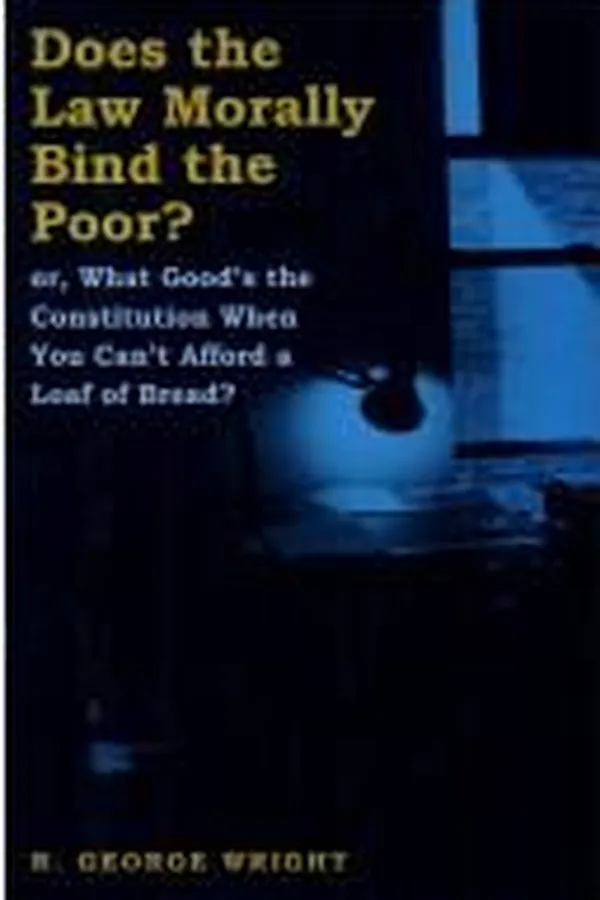
Does the law morally bind the poor? or, What good's the Constitution when you can't afford a loaf of bread?
por
Imagine you return home one day to find the cords on your window sashes gone. A number of reasons for their disappearance might occur to you. Most of us, however, would not immediately consider that intravenous drug users had taken …
- ● 83% match for you
- ● science & technology
the long version
Imagine you return home one day to find the cords on your window sashes gone. A number of reasons for their disappearance might occur to you. Most of us, however, would not immediately consider that intravenous drug users had taken the cords for the purpose of fixing. Yet, for some, this possibility would seem quite likely. Or consider the horror we feel when we learn of a crime such as that committed by Robert Alton Harris, who commandeered a car, killed the two teenage boys in it, and then finished what was left of their lunch. What we don't consider in our reaction to the depravity of this act is that, whether we morally blame him or not, Harris has led a life almost unimaginably different from our own in crucial respects. . In this book R. George Wright traces the most basic legal and political implications of life in circumstances far bleaker than those with which most of us are familiar. While the poor live in the same world as the rest of us, he argues, their world is crucially different. The law, however, fails to recognize this difference. By not taking proper account of the circumstances of the severely deprived, we often make assumptions that violate logic and fairness. Wright's analysis explores the Constitution as it is applied to the poor in our society. He then argues that the law is inconsistent in excusing the trespasses of persons fleeing unexpected storms but not those of the involuntarily homeless. He persuasively concludes that we can reject crude environmental determinism withot holding the most deprived to unreasonable standards.
Margaret's verdict
"Imagine you return home one day to find the cords on your window sashes gone. A number of reasons for their disappearance might occur to you. Most of us, however, …"
highlights
what readers held onto
No highlights yet. Be the first.
discussion
what readers said
No reviews yet. Finish it; tell us what you found.


